

I wrote a book the other day.
Not quite. I wrote a book over nine months, the way anyone does. But the part that would have taken a traditional author two to five months of sustained drafting took fifteen days. The manuscript went from outlined source material to 50,000 approved words in just over two weeks, across 24 chapters, five independent quality gates, and two separate language models providing structural correction passes.
The book is called Centrifuge: Inside the Emerging AI Organization. It argues that AI reveals what organizations actually are and accelerates the separation of genuine capability from performed competence.
The Proposal
A few years ago, I wrote a proposal for a bioinformatics company. I could not get a word on the page.
Not because I lacked ideas. Because every sentence demanded two things simultaneously: the right idea and the right words for it. I would organize and reorganize. I would find a word, decide it was not quite the word, hunt for a better one, lose the thread of the paragraph while hunting. The blank page did not care that I knew the material. It wanted finished prose, in order, at publication quality, from the first keystroke.
When the writing finally came, it came fast. The finished report received considerable praise.
That was not my first proposal. I write proposals, reports, analyses, assessments. I write all the time. Sometimes everything flows quickly, but usually that’s because I’ve already been writing in my head for hours, days, or weeks before I sit down. Other times I sweat over every word, and getting the first one on the page is the hardest part. That proposal was one of those.
The bottleneck was never the thinking. It was the mechanical burden of converting thought into text.
What Changed
AI dissolved that barrier. Not the thinking. The barrier.
When I wrote Centrifuge, I did not compose polished prose from a blinking cursor. I dumped ideas in rough form. Sloppy sometimes. Stream-of-consciousness where the idea was still forming. Serviceable but ineloquent where I knew what I wanted to say but did not need to say it beautifully. I offloaded the readability, the transitions, the general eloquence to the production system.
Sometimes I wrote traditionally because I needed to capture a particular feeling. Something intense or something subtle. Those passages required my hand on every word because the specific emotional register was the point, and no language model reliably produces emotional precision from instruction. And sometimes a turn of phrase would occur to me, or a particular way of landing an idea, and I would just write that directly. There is a fair amount of that sprinkled through the book.
Everything else, the system handled the mechanical construction. I handled the judgment.
I’m told I write well. For decades, I’ve been told that. I hope it’s true, but what I know is true is that I’m a very slow writer. Or at least I was. LLMs are a great equalizer for me. I can now get the substance of my ideas into the marketplace at the speed other writers always could.
Where the Work Went
People hear this and assume it means less work. It does not. The work moved.
I spent 34 articles over eight months developing the arguments that became raw material for the book. Of those roughly 64,000 published words, perhaps 10 to 20 percent of the unedited prose was mine directly. The rest was AI-produced under my direction, correction, and approval. But every argument, every structural decision, every position those articles took originated in my thinking. The AI handled the prose. I handled the substance.
Then the book production itself. Across 24 chapters: architectural contracts specifying what each chapter would argue. Corrections when a draft fabricated something I never said. Rejections when a structure failed to cohere. Fifty-eight production decisions recorded in the project bible. Four versions of the outline. Five quality gates. A knowledge base that had to remain navigable across months.
The total effort landed between 235 and 335 hours. Nearly all of it was intellectual: conceiving, organizing, directing, correcting, measuring, and deciding. The mechanical work of translating all of that thinking into polished manuscript prose ceased to be my job. It did not cease to exist. It just stopped being the thing I spent my time on.
The Translation Layer
The same structural change had already appeared in software.
Writing has always imposed a translation layer between the idea and the artifact. You think something. Then you must mechanically construct sentences that convey it, in sequence, with the right words, at the right pace. That translation requires skill. It also consumes enormous time and energy that have nothing to do with whether the underlying thinking is any good.
Software imposes a heavier version of the same barrier. An idea for a tool, an application, a system has to cross a substantial mechanical threshold before becoming something that runs. Syntax, framework conventions, boilerplate, implementation mechanics, debugging. A vast apparatus stands between specification and working software.
AI absorbs much of that translation layer. Not the thinking above it. Not the judgment about what to build, why, or whether it works. The mechanical middle.
This does not eliminate software expertise. Requirements gathering, problem decomposition, structured frameworks, architectural discipline still determine how good the result is. But the barrier that once required professional mechanical competence just to participate has lowered substantially. The question shifted from “can you write the code” to “do you know what needs to be built.”
The same shift had already happened in writing. The question became whether you had something worth saying, not whether you could construct a grammatical paragraph. It happened in analysis. The question became whether you knew what to ask the data, not whether you could build a pivot table.
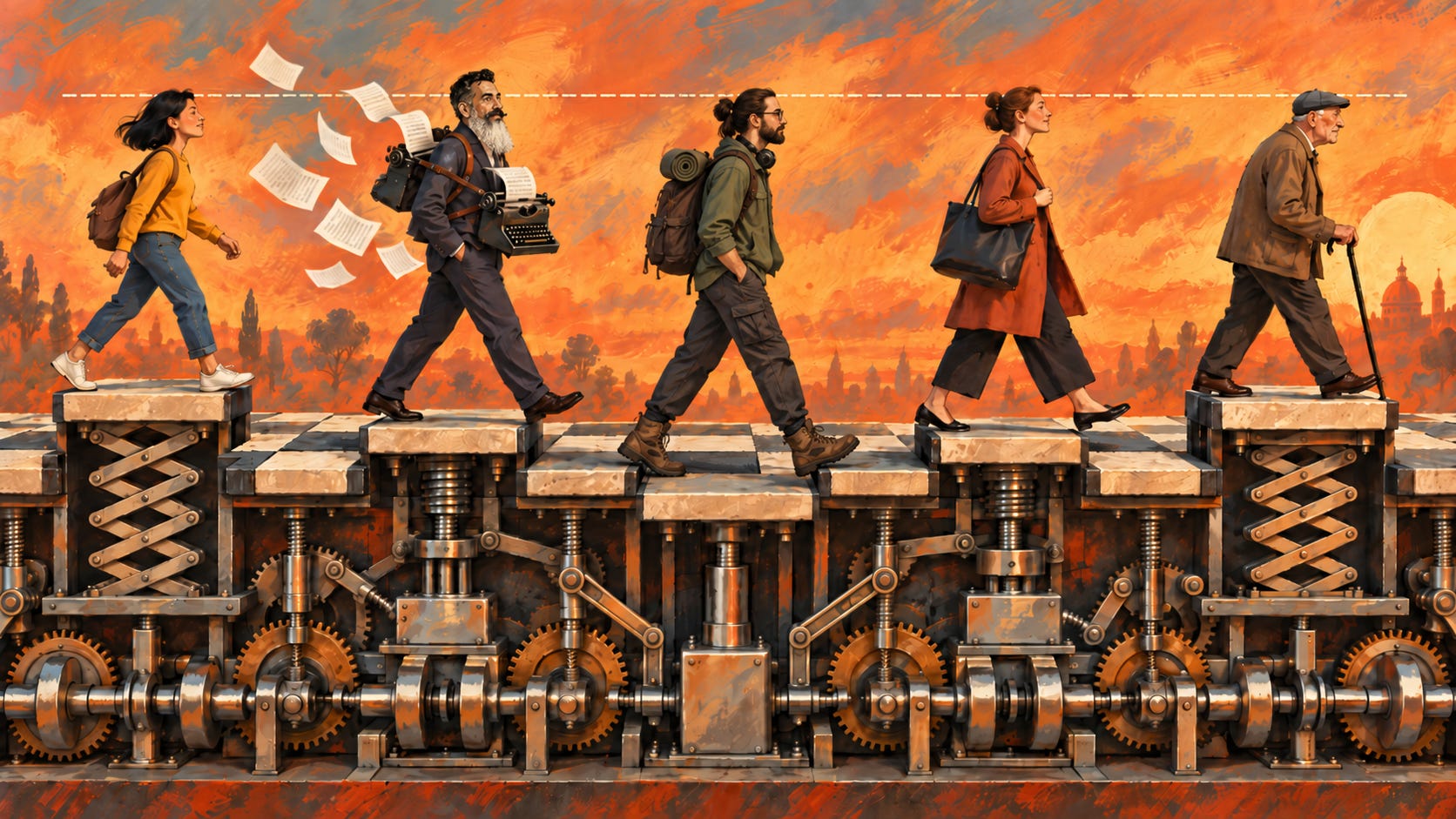
I started calling this the mechanical floor. Not a guarantee of competence. A removal of previously specialized mechanical skill from the price of entry. The floor rises because the machinery becomes available. The ceiling remains where it always was: judgment, expertise, rigor, discipline, talent.
The floor is rising in science.
The Question
I started paying attention to this after hearing someone make confident, authoritative claims about red light therapy. Specific wavelengths, specific durations, specific cellular mechanisms. I had heard similar confidence about cold exposure protocols, peptide regimens, supplement stacking for targeted biomarkers.
The truth is, nobody really knows what an effective protocol is for these interventions. Some of these people were repeating what they had read. Others were designing structured experiments on themselves and tracking outcomes with measurable rigor. The difference was not credentials. It was methodology.
I found myself asking: has AI lowered the mechanical floor for science the same way it lowered it for writing, for analysis, for software? If it has, how long before non-credentialed individuals are producing structured, methodologically sound work that would not have been possible without institutional infrastructure a decade ago?
Where the Floor Is Now
The measurement infrastructure for personal health experimentation is consumer electronics. Continuous glucose monitors are over the counter. Wearable ECG transmits from your wrist. Blood pressure, sleep architecture, heart rate variability, activity, and mood are captured continuously by devices people already carry.
The analytical tools are accessible to anyone who can describe what they want to test. Protocol design, literature review, randomization schedules, data cleaning, model fitting, visualization, and plain-language interpretation of serial measurements with explicit uncertainty.
The methodology for rigorous individual experimentation has existed for forty years. N-of-1 randomized controlled trials appeared in the New England Journal of Medicine in 1986. The CONSORT reporting standards for single-patient trials carry 25 checklist items and 44 sub-items. The method was never the problem. The operations were. Someone had to randomize treatment periods, collect diaries, enter data, run serial analyses accounting for carryover and autocorrelation. For one person. The economics never worked inside institutions designed for populations.
AI is the operational infrastructure that makes the method practical.
The mechanical floor for health research just rose to “anyone with a valid question, a measurement device, and the discipline to follow a protocol.” Not everyone. Discipline and methodology are not automated. The floor rose. The ceiling is still set by the quality of the thinking.
That is exactly what the mechanical floor does in every domain it enters. It does not make everyone a great writer. It makes the tools accessible and redirects the competition to the thinking. It does not make everyone a great scientist. It lets the question, the rigor, and the intellectual honesty determine what the work is worth.
Where I Am Watching
The biology of aging is where I see this taking shape. Not necessarily where it will be most visible first, but where I am paying attention, because the field sits at the intersection of intense personal motivation, quantifiable biomarkers, accessible interventions, and a research establishment that moves at institutional speed on questions individuals want answered in their own lifetimes.
People are already tracking biological age through methylation panels, running structured supplement and pharmaceutical protocols with baseline and follow-up bloodwork, sharing their measurements with communities that provide replication and aggregation. They are not waiting for the institutional apparatus. They are generating data, structuring experiments, and accumulating observations because the tools now let them and the questions are too personal to delegate.
Some of them will be wrong. The floor rising does not mean standards fall. It means the tools to meet the standards are no longer locked behind institutional gates. The blank page of a research protocol now demands exactly what the blank page of a manuscript demands: not credentials, not mechanical skill, but judgment, discipline, and a question worth the effort of answering honestly.
I did not expect to arrive here by writing a book about AI and organizations. But the mechanical floor does not respect domain boundaries. It rises where the tools go. The tools went everywhere.