

“I don’t trust you.”
I typed that to ChatGPT on December 22, 2025, halfway through building a server in my house. Ten 12-terabyte drives, a migration of about 80 terabytes off an old machine, and for weeks ChatGPT had been my guide through all of it.
It had not been a good guide. It recommended cables too short to reach between the components. It proposed a power supply arrangement that needed four harnesses on a unit with three ports. That day it walked me through settings that did not exist in the version of the operating system installed on the machine in front of me, then did it again.
So I said I didn’t trust it, and then I asked a practical question: “I’m turning to Claude. Which model should I be using?”
ChatGPT answered. It recommended Claude Sonnet 4.5.
The incumbent named its successor. Switching cost me one sentence.
For the next nine months, Claude ran my builds. It wrote the inventory scripts and the scheduled jobs that kept the server running. By late January I told ChatGPT, in so many words, that Claude was superior for both coding and strategic thinking.
On September 24, 2026, I sent the same message in the other direction. I told ChatGPT it was taking over all of my server infrastructure work from Claude, effective now.
The lead was real, and it lasted nine months. Biology has a name for this kind of race.
Running to Stay in Place
In 1973, Leigh Van Valen, an evolutionary biologist at the University of Chicago, published a pattern he had found in the fossil record. Across group after group of organisms, the odds that a lineage would go extinct stayed roughly constant no matter how long it had already existed. Old lineages were no safer than young ones. Longevity bought nothing.
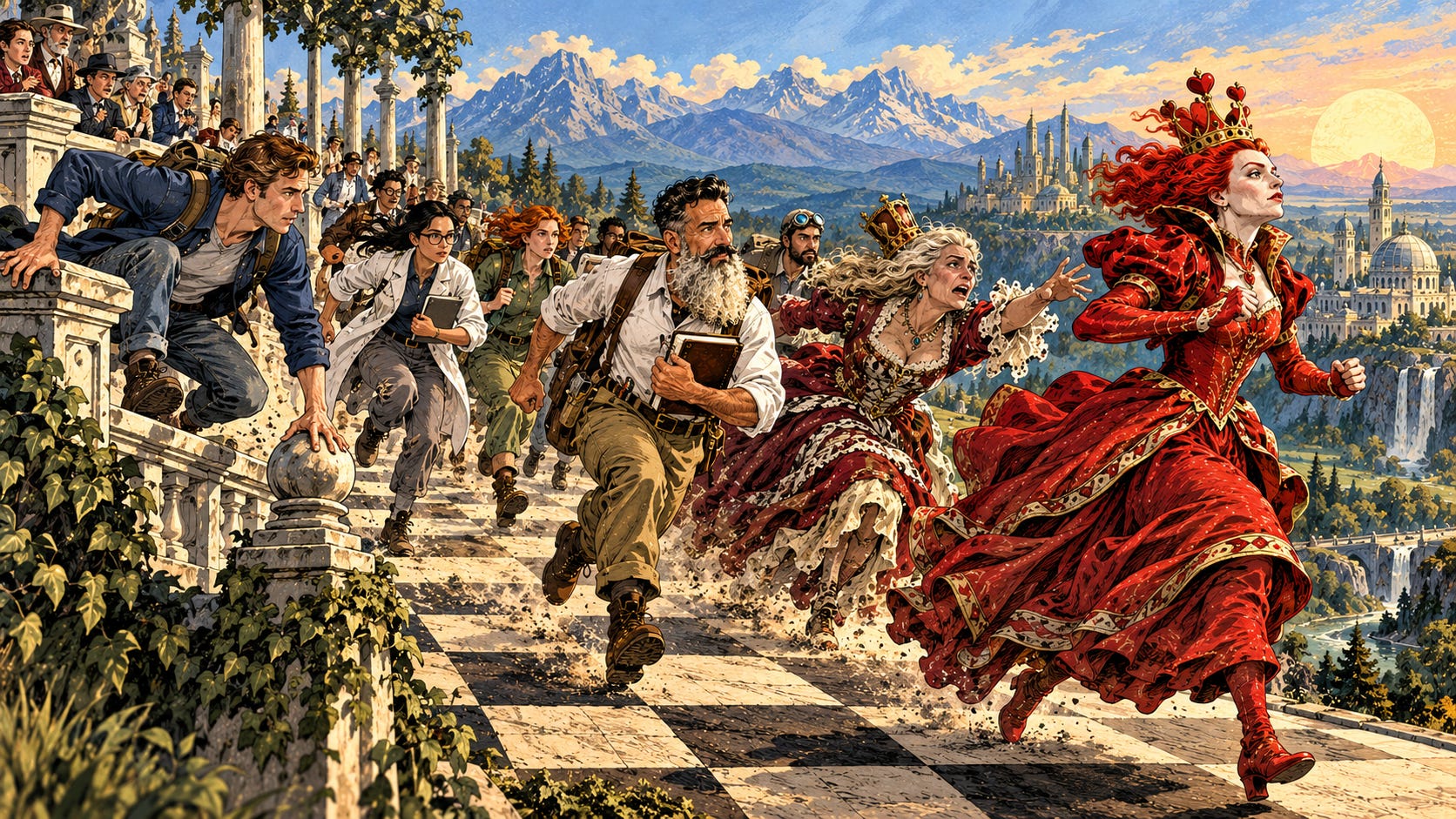
His explanation was that a species’ environment is mostly other species. Predators, prey, parasites and competitors are all evolving at once. Any improvement in one makes conditions worse for the others, so every species has to keep adapting just to hold its position. Van Valen called it the Red Queen hypothesis, after the character in Lewis Carroll’s Through the Looking-Glass who tells Alice, “Now, here, you see, it takes all the running you can do, to keep in the same place.”
The idea had trouble finding a home. Several leading journals rejected the paper. Van Valen founded his own journal, Evolutionary Theory, and published it on page one of volume one. It became one of the most durable ideas in modern biology.
Van Valen was not unusual. Lynn Margulis’s paper proposing that mitochondria began as free-living bacteria was rejected by about fifteen journals before one published it. Two cases do not make a law, but Thomas Kuhn described the mechanism that keeps producing them. Normal science runs inside a paradigm, and work that does not fit the paradigm reads at first less like a discovery than a mistake. That is why the institutions that certify knowledge are often the last place a new idea gets a hearing. Van Valen did not wait for one of them to change its mind. He built his own route.
The AI labs fit his model uncomfortably well. Each release worsens the position of every rival. Each rival answers. And the age of a technical lead buys nothing. Nine months at the front of my own work did not protect Claude on September 24. Customers, distribution and compute contracts can still make a durable business. What no company keeps for long is the best model. The running is real and enormously expensive, and the capability it produces does not stay owned.
Every Lap Makes the Runners Faster
Van Valen’s race has a constraint the AI race does not. Biology does move adaptations between lineages. Bacteria trade genes across species, which is how antibiotic resistance spreads. But nothing in the process chooses what to copy. Variation happens by chance, selection does the editing, and no gazelle can study why the cheetah got faster and redesign itself by Thursday.
AI competitors can. In February 2026, Anthropic reported that three Chinese labs had run more than 16 million exchanges with Claude through about 24,000 fraudulent accounts, training their own models on its answers. When Anthropic released a new model in the middle of the campaign, one of those labs redirected nearly half its traffic to the new model within 24 hours. In September, US security agencies said in a joint advisory that labs doing this see significantly shorter development timelines.
The result shows up in the gap between the frontier and the models anyone can download. In 2024, the best open models trailed the best closed ones by about a year. The UK’s AI Security Institute measured six to ten months through most of 2025 and four to seven months by July 2026. Epoch AI’s index put the gap near four months in the first half of this year. Not every measure agrees, and on some leaderboards the newest frontier releases have pulled ahead again. The direction over three years is still hard to miss.
Then there is the clock. In 1993, the mathematician and science fiction writer Vernor Vinge told a NASA symposium, “Within thirty years, we will have the technological means to create superhuman intelligence.” His deeper point was that once machines help build better machines, progress feeds on itself. By May 2026, Anthropic reported that Claude wrote more than 80 percent of the code merged into Anthropic’s own codebase. In September, OpenAI said its research organization now runs 3.1 workdays of AI agent effort for every workday of human labor.
The Red Queen describes the geometry of the competition. Vinge describes the clock.
Carroll imagined a world where you had to run as fast as possible to stay in place. He did not imagine every lap making you a faster runner.
No Gate Holds Forever
The same pressure works on every gate built around a capability.
Competition, leaks and regulation are different contests, but they share an asymmetry. The people maintaining a restriction have to hold it against every attempt. No single breach ends a regime, and most are small. But each one that succeeds moves the capability a little further out, and in a race where every lap is faster, the attempts keep coming.
On April 7, 2026, Anthropic announced Claude Mythos Preview and withheld it from general release, judging its ability to find and exploit software vulnerabilities too dangerous. Access went to a small coalition of defenders. According to Bloomberg, a small group of unauthorized users reached the model through a third-party vendor environment on the day it was announced and kept using it. In June, US export controls forced Anthropic to suspend access to two newly released models. The controls were lifted 18 days later.
Anthropic itself has said this kind of arms control is harder than the nuclear kind. Training runs are easier to hide than missile silos, the inputs are general-purpose, and the incentive to keep going quietly while others pause is enormous.
None of this makes restriction pointless. Containment buys time, and defenders use it. But a gate built around a capability that rivals can reproduce, leak or distill is a delay, not a wall. Restrictions shape when and through whom a capability arrives. They rarely decide whether it does.
The Spectator
Van Valen’s model has no place for a bystander. Even when biology shares an adaptation, no one is standing outside the race choosing what to pick up. The rest of the ecosystem only feels the race as pressure.
The AI race leaks. What one lab builds, others reproduce. What the closed labs reproduce, open models reach months later. Then the price falls. Epoch AI estimates that the cost of a fixed level of capability has been dropping by roughly an order of magnitude a year. Frontier becomes open. Open becomes commodity. Commodity becomes individual.
I have never picked a winner in this race. Twice, I picked up whatever was ahead at that moment, and each time it cost me one sentence.
That proves less than it seems to, and more. It does not prove that every independent researcher can do what a lab does. A model is not a laboratory. Access to one does not supply the training to know what to ask, the data to ask it about, the equipment to test the answer, or the judgment to tell a good answer from a fluent one. Those are still unevenly distributed, and they will stay that way.
What it does prove is that the floor moved. Work that once required a lab’s staff now costs a subscription or a download: reading a literature across three fields, writing the analysis code, checking the statistics in a paper, drafting a protocol, finding the flaw in an argument before a reviewer does. Those are some of the hardest parts of science, and for most of its history doing them well meant having an institution’s people around you. Capable help with every one of them is now available to anyone who asks.
That is where the inheritance matters. Margulis and Van Valen were turned away by the gatekeepers, but they still had universities, laboratories and students behind them. The independent researcher has historically had neither the gatekeepers’ approval nor the infrastructure. The race does not hand over the laboratory. It hands over the reading, the coding, the statistics and the second opinion, the intellectual work that used to need an institution’s people. The capability gap between a well-funded lab and a motivated individual does not close on the institution’s schedule. It closes on the race’s. The labs are running for their own reasons: market share, valuation, national advantage. The individual inherits the lap.
The Inheritance
December 22 looked like a breakup with a tool. It was a pickup.
The next pickup may not come from a frontier lab at all. It may be an open model a few months behind the leader, running at a fraction of the price. You do not have to stay at the front of the race to collect what it leaves behind.
The most important consequence of the AI arms race won’t be which company wins it. It will be what the rest of us inherit while they’re running.